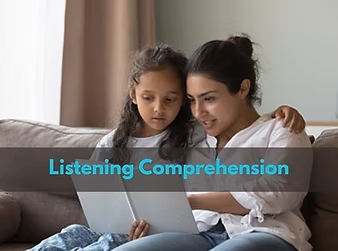
About Dynamic Assessment
Dynamic assessment (DA) evaluates how learners respond to teaching and support in real time. Rather than focusing solely on current performance, DA highlights learning potential, informs culturally responsive instruction, and provides actionable insights for educators and clinicians.

Why Dynamic Assessment
Promoting fair, accurate, and culturally responsive assessment practices.
Standardized assessments often disadvantage students whose first language or cultural background differs from test normative samples.
Research shows that tests built on “one-size-fits-all” assumptions are frequently used in ways that under- or over-qualify students from diverse backgrounds.
Many assessment experts argue that culturally responsive assessment practices are essential: they recognize students’ lived experiences and support fairer, more accurate evaluation.
Eight Dynamic Assessment-Compatible Modifications
Click on any item to expand and learn more about practical strategies.
1. Embed DA as a “Supplemental Layer”
2. Use a Test–Teach–Retest Format Around Discrete Subtests
3. Use Behavioral Observation Rubrics to Rate Modifiability
4. Administer Alternative Scaffolds After the Standardized Task
5. Use Dynamic Probes Instead of Full Retest
6. Document Responsiveness to Strategy Instruction
7. Use Structured Clinical Judgment Frameworks for Interpretation
8. Incorporate Metacognitive Reflection Opportunities
Summary Table: Balancing DA with Psychometric Integrity
See how key dynamic assessment strategies preserve scores while revealing learning potential.
Strategy
Test-Teach-Retest
Post-Item Mediation
Modifiability Rubrics
Dynamic Probes
Strategy Reflection
Preserves Score?
√
√
√
√
√
Adds DA Insight?
√√√
√√
√√
√√
√
Use For...
Intervention Planning, Response to Support
Learning potential, Zone of Proximal Development
Behavior/Process Analysis
Pattern Recognition, Fast Screening
Metacognitive Profiling
1
Narrative
Language
(ALL™ Subtests: Parallel Sentence Production, Listening Comprehension)
DA Adaptation
Model story structure or sentence elaboration strategies.
- Ex: Read a short story and highlight each part (beginning, middle, end) using color-coded visuals.
Model story structure or sentence elaboration strategies.
- Ex: Read a short story and highlight each part (beginning, middle, end) using color-coded visuals.
Model story structure or sentence elaboration strategies.
- Ex: Read a short story and highlight each part (beginning, middle, end) using color-coded visuals.
Testing the Limits Example
Parallel Sentence Production:
After the child fails to produce a complex sentence, the assessor might say: “Let’s think about why this sentence has two parts. Can you say it again using ‘because’ to explain it?”
Testing the Limits Example
Listening Comprehension:
After an incorrect answer to a story question, the assessor may ask, “What happened right before that? Can you remember what the character did next?”
Insight Gained: Modifiability in sentence structure formulation and understanding discourse-level information.
2
Phonological
Awareness
(ALL™ Subtests: Rhyme Knowledge, Elision, Sound Categorization)
DA Adaptation
Model story structure or sentence elaboration strategies.
- Ex: Read a short story and highlight each part (beginning, middle, end) using color-coded visuals.
Model story structure or sentence elaboration strategies.
- Ex: Read a short story and highlight each part (beginning, middle, end) using color-coded visuals.
Model story structure or sentence elaboration strategies.
- Ex: Read a short story and highlight each part (beginning, middle, end) using color-coded visuals.
Testing the Limits Example
Parallel Sentence Production:
After the child fails to produce a complex sentence, the assessor might say: “Let’s think about why this sentence has two parts. Can you say it again using ‘because’ to explain it?”
Testing the Limits Example
Listening Comprehension:
After an incorrect answer to a story question, the assessor may ask, “What happened right before that? Can you remember what the character did next?”
Insight Gained: Modifiability in sentence structure formulation and understanding discourse-level information.
3
DA Adaptation
Scaffold with visual alphabet charts or name-letter association games.
- Ex: Point to the student’s name and say, “This is the letter you start with.”
- Ex: Match alphabet cards to familiar environmental labels (e.g., M for McDonald’s).
- Ex: Use an ABC song chart and pause to ask the student for the next letter.
Teach phoneme-grapheme connections and observe response to immediate teaching.
- Ex: Say a sound and ask the student to point to or trace the letter.
- Ex: Use sand or shaving cream to write the target letter while saying the sound.
- Ex: Practice saying a letter sound while using a kinesthetic motion (e.g., air writing).
Reassess with novel letters or unfamiliar symbols.
- Ex: Introduce two new lowercase letters and ask the student to identify or match.
- Ex: Ask, “Can you find the letter that says /b/?” with a new set of cards.
- Ex: Observe if the student generalizes the strategy (e.g., sounding out unfamiliar letters).
Testing the Limits Example:
If a child misidentifies the letter ‘m,’ the examiner could say, “This is the letter in the word ‘mom’—do you remember what sound it makes?” and allow a second response.
Insight Gained: Supports differential diagnosis between delayed exposure and learning disability.
4
Decoding and Comprehension
(ALL™ Subtests: Sight Word Recognition, Listening Comprehension)
DA Adaptation
Use reciprocal teaching strategies for listening comprehension (predict, clarify, summarize).
- Ex: Before reading, ask, “What do you think will happen?”
- Ex: Pause during a story and ask the student to explain or clarify events.
- Ex: After reading, summarize the story together using key vocabulary.
For sight words, use multisensory strategies (e.g., trace and say) and evaluate modifiability.
- Ex: Trace high-frequency words in sand while saying each letter and word.
- Ex: Build sight words with letter tiles, then read them aloud.
- Ex: Use a “read it, build it, write it” approach for unknown words.
Reassess with novel letters or unfamiliar symbols.
- Ex: Introduce two new lowercase letters and ask the student to identify or match.
- Ex: Ask, “Can you find the letter that says /b/?” with a new set of cards.
- Ex: Observe if the student generalizes the strategy (e.g., sounding out unfamiliar letters).
Testing the Limits Example
Sight Word Recognition:
After an incorrect sight word, prompt with: “This word starts with ‘th’ like ‘the.’ Try it again—what do you think it says?”
Testing the Limits Example
Listening Comprehension:
If a student answers a comprehension question vaguely, say: “Let’s go back and think—why did the girl go into the forest?”
Insight Gained: Determines if child benefits from explicit instruction, indicating high learning potential.
5
DA Adaptation
Provide modeling of tracking, pointing, and concept of print.
- Ex: Model pointing under each word as you read and have the student copy.
- Ex: Show the front/back of the book and let the student hold and open it.
- Ex: Demonstrate where the title and author are located on a cover.
Allow practice and retesting to examine change in performance.
- Ex: After modeling, give the student a new book to demonstrate tracking.
- Ex: Re-assess pointing while reading a line of familiar text.
- Ex: Have the student retell what a word or sentence means using print cues.
Testing the Limits Example
Book Handling:
After a child opens the book backwards, the assessor might say: “How do we start a story? Which side do we open first?”
Testing the Limits Example
Concept of Word:
If the child cannot track print, say: “Watch my finger. Now you try—can you point to each word as I read it again?”
Insight Gained: Differentiates between instructional experience and skill-based difficulty.
6
Oral Language Comprehension and Expression
(ALL™ Subtests: Following Directions, Expressive Language Tasks)
DA Adaptation
Introduce chunking or visual mapping for multi-step directions.
- Ex: Break long directions into parts using visual steps (e.g., pictures on a strip).
- Ex: Say one step at a time and use physical objects to model the action.
- Ex: Draw boxes for each step and have the student check them off after completing.
Use sentence starters or models to elicit expressive syntax.
- Ex: Use prompts like “I see ___ at the ___” to help structure responses.
- Ex: Model full sentences and ask the student to finish or repeat them with changes.
- Ex: Provide sentence strips with word choices to complete thoughts.
Offer targeted feedback and re-assess with similar tasks.
- Ex: Give feedback such as, “Try starting with ‘I think…’” and listen to changes.
- Ex: Repeat a similar question with new vocabulary and observe improved structure.
- Ex: Ask the student to try the same task with a different topic to see if skills transfer.
Testing the Limits Example
Following Directions:
If a student misses a two-step direction, break it down: “Let’s try that one again. First touch the red block, then the blue—can you do both now?”
Testing the Limits Example
Expressive Language:
If a child gives a fragmented response, say: “Can you make that into a full sentence? Try starting with, ‘I saw the…’”
Insight Gained: Differentiates between performance based on unfamiliar structure vs. core comprehension/production difficulty.
Frequently asked questions
What is Dynamic Assessment (DA)?
DA evaluates how learners respond to teaching and support in real time, highlighting learning potential rather than just current performance.
Who can use these resources?
Educators, reading specialists, speech-language pathologists and other professionals can use these tools to guide culturally responsive, strengths-based assessment and instruction.
Do I need special training to use these strategies?
The resources are designed to be practical and accessible, with guidance built in. Additional professional development, available through REACT Initiative, Inc. for ASHA CEUs, can deepen understanding.
Why is Dynamic Assessment necessary?
Dynamic assessment uncovers learners’ true potential by showing how they respond to instruction and support, helping educators make more accurate, strengths-based, and culturally responsive decisions.
How do I start using these resources?
Begin by exploring the Dynamic Assessment strategies and subtests most relevant to your learners. Use the interactive tools and examples to guide implementation step by step.
Are there guides or examples for implementing DA in the classroom or clinic?